
A Residence Diary May in the Novara rice fields
When the plain floods, the sky doubles on water, and the herons return to be counted again, five minutes from the gate of the Residence.
There is a moment, every spring, when the plain around Lumellogno stops being what it seemed. The country roads stay where they were, the trees too, but between one strip of land and the next, water appears. Low, still, gleaming. This is the submerged countryside, the landscape that, for a few weeks each year, makes the Novara plain one of the most singular places in Italy.

The submerged countryside: what happens in May
Between the end of April and the first days of May, the water comes in. It arrives through canals and channels that cross the plain. The main artery is the Canale Cavour, which since 1866 has fed the entire rice-growing district of Novara. The water is parcelled out with patient method into every cultivated “chamber” of land, and there it stays. It stays for four, six, eight weeks: the time the rice grain, sown in the mud, needs to germinate sheltered from the night chill, then to break the surface and begin to tint the landscape a tender green. The technique is over five centuries old, and is still the way our Carnaroli and Arborio, grown across three hundred and fifty hectares, come into the world. For those weeks, the landscape wraps itself around the Residence all the way to the gate.
The Residence stands inside this landscape, not beside it. The first heron you see is the one you meet when you step out of the door, not the one you set out to find. For anyone used to rice fields as a tourist tableau, that is the difference you remember. On clear days, on the horizon, the Antonelli dome of Novara rises across the water, the counterpart of Turin’s Mole, five or six kilometres away.
The return of the herons: little egrets, greys, night herons
We have been growing rice in these fields for decades. The herons live here. They cross the fields, stop on the water, fly over the embankments. Anyone who walks the country roads in spring meets them often, without needing to look.
When the water is still, and the frogs return to it, the herons reappear. The phenomenon is old, and so structural that the Novara plain, together with the lower Lomellina and the Pavese, is among the most important habitats in Europe for the Ardeidae, the family of birds that includes herons and their relatives. Three of them you will recognise from the gate of the Residence, with no need for binoculars, in the first two weeks of May.
The grey heron (Ardea cinerea) is the most recognisable: nearly a metre tall, ash-grey plumage, wide wings, slow regal flight. You will see it standing motionless on an embankment, in ambush, or crossing a field with three or four sovereign wingbeats. The little egret (Egretta garzetta), smaller, snow-white, with black legs ending in yellow feet, comes to the fields in small groups and lets itself be watched well by anyone who walks unhurried. The night heron (Nycticorax nycticorax), more elusive, active at twilight, is the gift granted to whoever lingers outdoors until sunset: black crown, dark back, pale belly, a hoarse call that travels through the evening air.

The Japanese dawn and the sunset on water
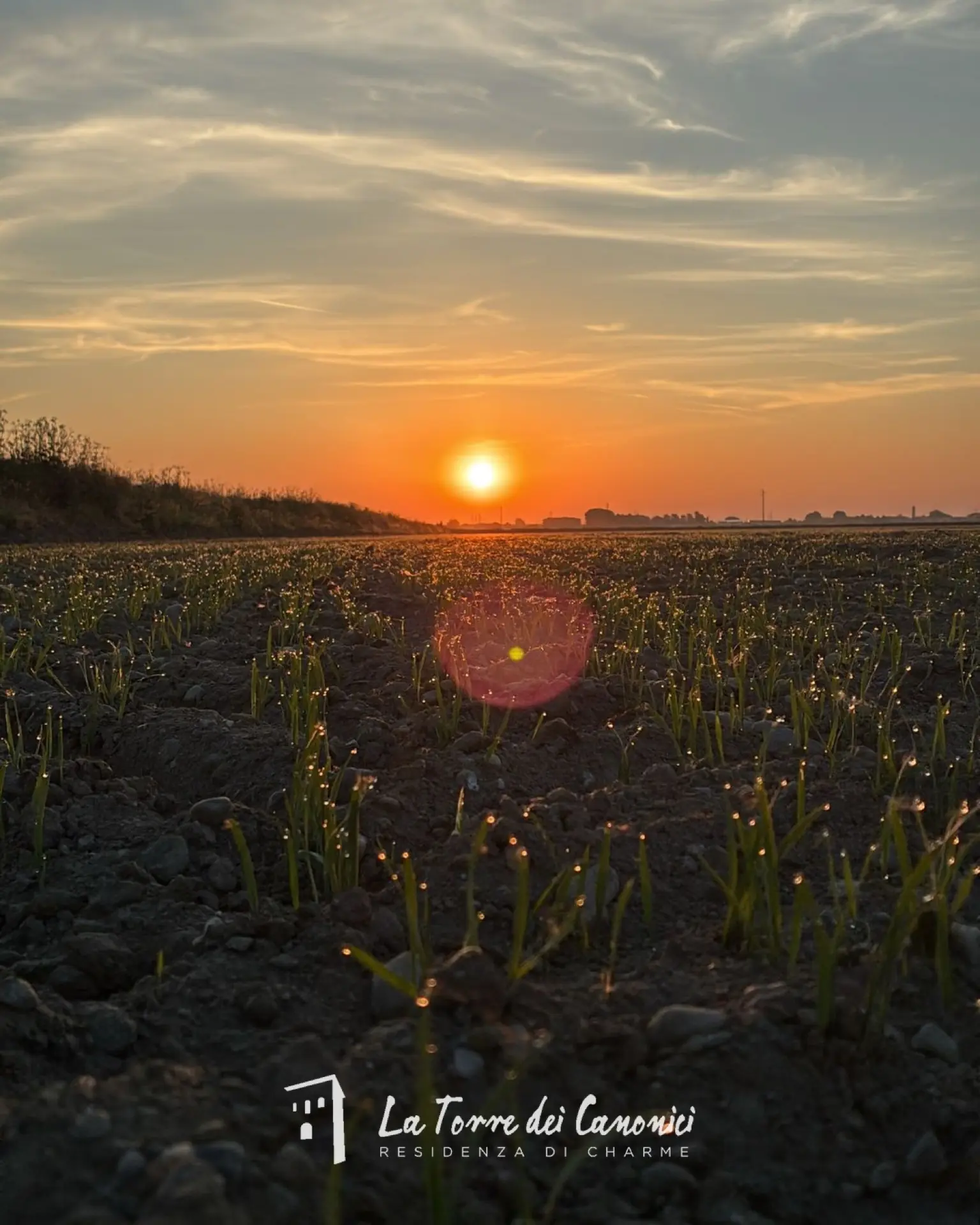
There are two moments, in May, that the countryside around Novara offers to those who rise early and to those who stay out late. The first is dawn. When the night air is still cooler than the water in the fields, a low, fine mist forms over the surface, floating a hand’s width above it and covering the embankments like gauze. The sun, rising behind the plain, cuts the mist into oblique blades and gives the scene a Japanese effect that many photographers chase for years on other continents, and which here, in May, is simply what happens every fair morning.
The second is sunset. The low light paints the reflections on the water pink, orange, copper; the herons cross the frame in slow flight, the swallows slice it in short dives, the distant fields turn to silhouettes against the sky. It is an hour that asks for silence. You step out with a light jacket, sit on an embankment, look. You return to the Residence for dinner with your mind already elsewhere.
At neither hour, dawn or sunset, do you need to drive far. The rice fields begin where our garden ends. A camera is welcome, but not necessary. The eye is enough.
How to live the landscape: on foot, by bike, from the Residence
For those who stay at La Torre dei Canonici, the most honest way of entering this landscape is to step out of the gate and walk. The country lanes, unsurfaced, flat, well marked, leave from the Residence and lose themselves in the water. They are not on any portal, they have no booking page. They are found. Here are five ways we suggest to our Guests.
Five ways to read the landscape
- At first light, on foot. Out before sunrise, ten minutes’ walk from the gate, the mist hovering above the water. Bring a warm layer. The mornings of early May are still cool.
- On a mountain bike, mid-morning. Bicycles are available at the Residence. The lanes between the paddies are smooth and flat. Half an hour is enough for the loop that returns by the canal.
- With binoculars, from the garden. A pair of binoculars (which we are introducing in the coming weeks) makes the herons unmistakable, even at a distance. Best between nine and eleven in the morning.
- At sunset, sitting still. An hour before the sun sets, find an embankment. Stay until the light becomes copper. Return slowly.
- At dusk, near the canal. The night herons emerge as the sun drops. Quiet voices, slow steps. Bring a torch for the way back.
The first heron you see is the one you meet when you step out of the door, not the one you set out to find.
May at the Residence
We look forward to welcoming you in Lumellogno.
For a May stay at the Residence, the window is between late April and mid-June. Those who want to see the rice fields flooded have only a few weeks. The Residence is open in these months, and from the gate you step straight into the water.
To photograph dawn over the rice fields, a suggestive landscape that changes every morning with the low mist, you need directions that maps do not carry: the right embankment, the right hour, the direction of travel that keeps you out of the glare, the spot where the mist forms first. We share them with those who stay with us, not with those who book through a portal. We call them a rice grower’s details, and we share them gladly.
Write to us with your dates. We will suggest the best hours for the light, the inner itineraries, and the binoculars for the herons. We await you.