
The Cupola Antonelliana, our daily neighbour
One hundred and twenty-one metres of brick to the tip of the spire, one hundred and twenty-six with the statue of the Saviour. You can pick out its outline from miles away, and a ten-minute drive takes you right up to it.
This is the dome of the Basilica of San Gaudenzio, which everyone in Novara simply calls the Cupola Antonelliana, after the architect who imagined it. Alessandro Antonelli designed it, the same man behind Turin’s Mole, and building it took more than forty years. It is still the shape by which the city announces itself, long before you reach the centre.
How tall is the dome of Novara?
The dome reaches one hundred and twenty-one metres at the top of the spire. Counting the statue of the Saviour that crowns it, the total is one hundred and twenty-six metres from the floor of the basilica. It is the tallest dome in Italy: in Europe only the dome of St Peter’s in the Vatican, at one hundred and thirty-six metres, and the new cathedral of Bucharest rise higher. What stays with you, more than the figure, is how it was built: entirely in brick and lime, with no iron in the structure, one of the boldest masonry constructions ever raised.
The profile you recognise from afar
Anyone approaching Novara across the plain meets it before entering the town: a slender shape rising above the rooftops, visible from a long way off. It is the dome of San Gaudenzio, set on a basilica of late sixteenth-century design by Pellegrino Tibaldi. Antonelli turned it into something never seen before, a brick dome carried by four pairs of masonry arches arranged in a square, drawn upwards like a spire. For our guests it is the first thing we point to when we look towards Novara, and almost always the first outing we suggest.
Dome, Mole, Duomo: setting things straight
Four monuments often get mixed up, and there is a good reason: the same hand lies behind several of them. The dome of San Gaudenzio is in Novara, and it is the one this page is about. The Mole Antonelliana, on the other hand, is in Turin: Antonelli began it in 1863, almost twenty years after opening the Novara site, and it now houses the National Cinema Museum. If you were looking for “the Mole of Novara”, this dome is the one you mean.
Beside the basilica stands the bell tower, built by Benedetto Alfieri between 1753 and 1786, a separate structure raised a century before the dome. And the Duomo of Novara is yet another church, the cathedral, which Antonelli rebuilt in neoclassical form. No monumental dome, but next to it stands the Early Christian Baptistery of the fourth and fifth century. Four different works, three of them tied to the same architect, which is why they are so easily confused.
- Dome of San Gaudenzio, Novara, Alessandro Antonelli (1844-1887): the basilica’s dome, 121 m, 126 m with the statue
- Mole Antonelliana, Turin, Alessandro Antonelli (from 1863): a building in its own right, now the National Cinema Museum
- Alfieri bell tower, Novara, Benedetto Alfieri (1753-1786): a bell tower beside the basilica
- Duomo of Novara, Novara, rebuilt by Antonelli: the cathedral, with the Early Christian Baptistery beside it

Antonelli and a lifetime on one site
Alessandro Antonelli was born in Ghemme, near Novara, in 1798, and died in Turin in 1888. His first design for the dome dates from 1841, but the real building work began in 1844 and carried on for more than forty years. The shell of the dome was closed in 1863, the spire rose between 1876 and 1878, and the strengthening of the piers continued until 1887. Antonelli worked on it to the end of his life. The result is a single structure, built entirely in brick and lime. To give it height while keeping it standing, Antonelli set it on four pairs of masonry arches arranged in a square, which carry the load downwards. The figures say more than any adjective: two thousand and forty-six cubic metres of brick, five thousand five hundred and seventy-two tonnes not counting the great arches. No iron in the structure, at a time when steel was already coming into use.
- Architect: Alessandro Antonelli, 1798-1888
- Construction: from 1844, more than forty years of work, completed 1887
- Height: 121 metres to the spire, 126 metres with the statue of the Saviour
- Structure: all in brick and lime, 2,046 cubic metres, on four pairs of masonry arches arranged in a square
- At the top: the statue of Christ the Saviour, almost 5 metres, bronze with gold leaf, by Pietro Zucchi
The statue at the top, and where it really is
A statue stands at the very top of the spire: Christ the Saviour, almost five metres tall, in bronze covered with gold leaf. The sculptor Pietro Zucchi made it, and it was raised up there on 16 May 1878, a day Novara still remembers. There is a detail almost no one knows, though: what you see from below today is a fibreglass copy, put in place in the nineties. The original, too heavy to stay at the summit, was lowered and can now be admired up close inside the basilica.
How to visit and when to go
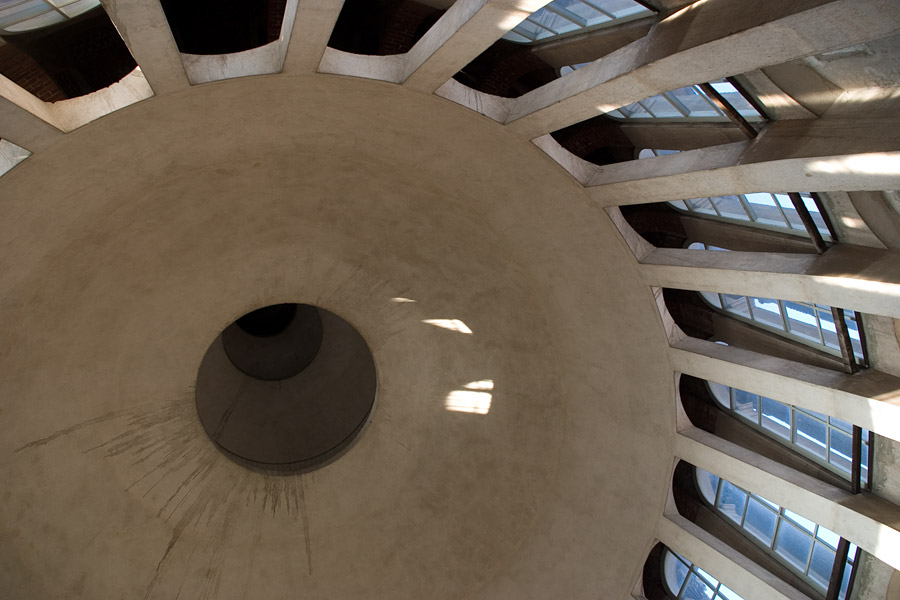
Entering the Basilica of San Gaudenzio is free during opening hours, except during services: you cross the nave and look up into the dome. That alone tells you the scale of it. Going up is another matter: only on a pre-booked guided tour, at weekends and on public holidays. Places are limited, and we are glad to help you book. There are two routes. The first reaches the dome, at around seventy-five metres. The second climbs to the spire, at one hundred metres, up four hundred and seventy-eight steps, with helmet and harness: more a vertical climb than a tour, and from the top, when the air is clear, the view stretches from the Alps to the skyscrapers of Milan. If you would like a tip on timing, choose the early afternoon, when the light sets the red of the brickwork alight.
- From the Residence: about 5 km as the crow flies, about 7 km by road, 10-15 minutes by car
- Basilica entry: free during opening hours, except services
- Climb to the top: pre-booked guided tours only, at weekends and on public holidays
- Two routes: to the dome, around 75 metres; to the spire, at 100 metres, 478 steps, with helmet and harness
- When to go: early afternoon for the light on the brickwork
Three good reasons to go
A feat in brick
A one-hundred-and-twenty-one-metre dome built of brick and lime alone, with no iron: very few works in Italy bear comparison with it. Seen from below, inside the nave, it is already worth the trip.
The view from the spire
Those who climb the hundred metres to the spire see, on a clear day, the arc of the Alps on one side and the skyscrapers of Milan on the other, with the Novara plain spread out below like a map.
Minutes from the Residence
From our home in Lumellogno the dome is about a ten-minute drive. It is the first place we suggest to guests who are new to the Novara countryside.
Half a day in Novara
If you are staying with us and the town is new to you, start here. The dome is the most direct way to take the measure of the area, and around the basilica there is enough for half a day on foot: from the basilica, where San Gaudenzio rests, a short walk brings you to the Alfieri bell tower and then to the Duomo, with its Early Christian Baptistery standing beside it. We put together a small map for you and tell you when the light is at its best. As for booking the climb, which is not always straightforward, we are happy to help. It will be our pleasure to welcome you.
Frequently asked questions about the dome of Novara
How tall is the dome of Novara?
One hundred and twenty-one metres to the spire, one hundred and twenty-six with the statue of the Saviour on top. It is the tallest dome in Italy and among the tallest in Europe.
Who built the Cupola Antonelliana?
It was designed by Alessandro Antonelli, the architect behind Turin’s Mole. Work began in 1844 and lasted more than forty years, until 1887.
What is the difference between the dome of Novara and the Mole of Turin?
They are two different works by the same architect. The dome of San Gaudenzio is in Novara, the Mole Antonelliana is in Turin and now houses the National Cinema Museum. “The Mole of Novara”, as people sometimes call it when searching online, is in fact this dome.
Can you climb the dome?
Yes, but only on a pre-booked guided tour, at weekends and on public holidays. There are two routes: one reaches the dome at around 75 metres, the other the spire at 100 metres, up 478 steps, with helmet and harness.
What can you see from the spire?
On a clear day the view stretches from the arc of the Alps to the skyscrapers of Milan, with the Novara plain spread out below.
Is the statue at the top the original?
No. The one visible from below is a fibreglass copy. The original, in bronze with gold leaf, by Pietro Zucchi, is kept inside the basilica and can be seen up close.
How far is the dome from La Torre dei Canonici?
About 5 kilometres as the crow flies, a ten-minute drive from our Residence in Lumellogno. It is the first visit we suggest to those new to the Novara countryside.
- Hero – Cupola Antonelliana and Alfieri bell tower, photo by Twice25 and Rinina25, Wikimedia Commons, CC BY-SA 3.0
- History – Dome of San Gaudenzio, photo by Umby, Wikimedia Commons, CC BY-SA 3.0
- Visiting – Interior of the dome, photo by Alessandro Vecchi, Wikimedia Commons, CC BY-SA 3.0